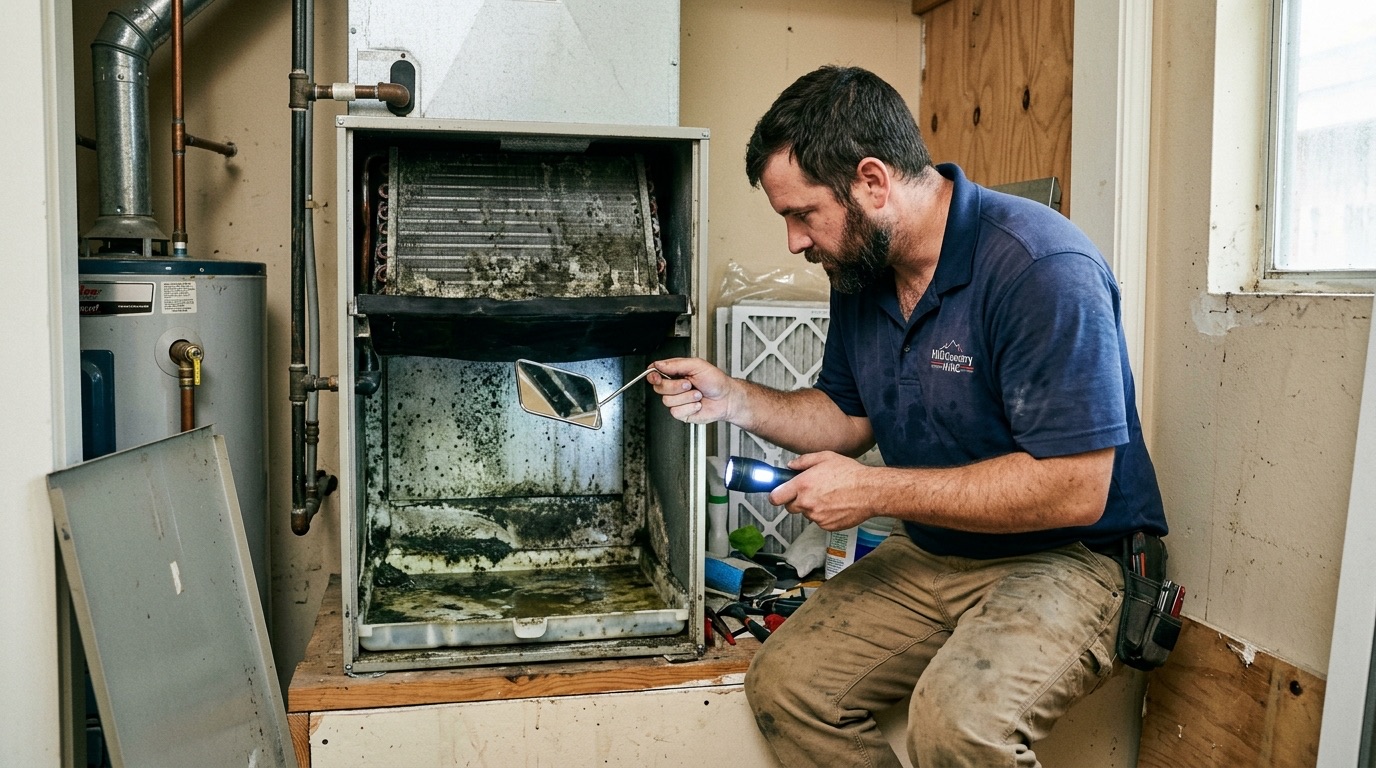
When mold infiltrates your HVAC system, the air carries spores throughout every room whenever it runs. If you notice a musty smell with your AC or see dark streaks near your supply registers, it's likely a common issue we handle for HVAC mold removal Austin services in Travis, Williamson, and Hays counties. As a TDLR-licensed Mold Remediation Contractor, we address evaporator coils, flex duct, air handlers, and condensate systems. For detailed insights into our services, check the full breakdown of what we do.
Why Central Texas AC Systems Grow Mold
Austin's heat and humidity create a prime setting for mold inside ductwork. Running your AC for most of the year offers plenty of chances for moisture to accumulate in unseen spots.
The evaporator coil plays a significant role. It extracts moisture from the air during operation, which drains away via a condensate line. If blocked, this line causes water to back up onto the drain pan, leading to overflow. Mold can establish within 24 to 72 hours on the wet metal and insulation around the coil.
Oversized units often plague the Austin metro area. These units cool quickly but shut off before dehumidifying properly, making ducts colder than surrounding air, leading to condensation inside duct walls. Flex duct, prevalent in Hill Country homes and pier-and-beam constructions near Brushy Creek, is especially susceptible because its folds trap moisture and debris. Inadequate soffit and ridge ventilation problems can result in both attic mold and duct condensation on the same property.
Where Mold Hides in Your HVAC System
Mold doesn't stick to one area. During a visual mold inspection, we often find it in:
- Evaporator coil and drain pan: The coil's fins are prime spots for mold. The drain pan collects water if the condensate line is slow or clogged.
- Supply and return plenum: These sections above and below the air handler collect dust and debris, and moisture from a leaking coil can seep in.
- Flex duct runs: Areas that sag, pinch, or touch unconditioned surfaces are vulnerable. Sagging ducts can pool condensate.
- Supply registers and grilles: Discoloration around registers might be an early warning of deeper issues.
- Air handler cabinet: Foam lining inside can absorb moisture and harbor mold long after initial moisture sources dry out.
If you're uncertain about what to look for, we can guide you through your system. For more details on how a site visit and damage check works, that page explains visual evaluations and moisture assessments.
Our HVAC Mold Removal Process
We adhere to the IICRC S520 Standard for Professional Mold Remediation on every task. Here's what our process typically includes:
Visual inspection and moisture assessment. We inspect the system from the air handler to each supply and return grille. Visible mold, water stains, standing water in the drain pan, and condensate line flow get checked. Moisture meters help us assess water spread into materials.
Containment setup. Based on contamination spread, we establish negative-air containment around the air handler and affected duct sections to prevent spores from reaching clean areas.
Evaporator coil cleaning. We apply coil-safe cleaner, flush the condensate line, and clear the drain pan. Severely corroded drain pans or those permanently contaminated get replaced.
Flex duct evaluation and replacement. We replace flex duct that is visibly contaminated, structurally damaged, or has pooled water rather than just clean it. We manage the project-management side of the work to ensure replacements fall within a single remediation scope.
Antimicrobial application. We apply an EPA-registered antimicrobial to hard ducts' interiors, air handler cabinet liners, and the drain pan. This treatment complements, not replaces, physical removal of mold.
Post-work visual review. After removing containment, we perform a final walkthrough. If written clearance is required, an independent licensed Mold Assessment Consultant handles that step. We partner with licensed MACs for post-remediation verification and can coordinate a referral.
Residential and Commercial Service
Though most HVAC mold calls come from homeowners and landlords, we also handle commercial rooftop units and large air handlers. We set up after-hours work for businesses to prevent disruptions during business operations.
What HVAC Mold Removal Costs in Austin
Costs depend on contamination spread, whether flex duct needs replacement, and air handler accessibility. According to Angi Austin mold remediation cost data, HVAC duct cleaning for mold typically costs between $300 and $1,000 in this area. Jobs involving coil cleaning, drain pan service, partial flex duct replacement, and antimicrobial treatment can go from $1,500 to $3,500, or more, depending on system size.
You'll receive a written scope with itemized details before we begin. No surprises here.
Why Property Owners Across Central Texas Trust Us
We are a TDLR Mold Remediation Contractor with IICRC AMRT certification. We follow IICRC S520 standards for every job, responding within 24 hours.
We collaborate with independent licensed Mold Assessment Consultants for written remediation protocols or post-remediation verification, as required by Texas Occupations Code Chapter 1958.
Call us through our contact form or book a slot today. We serve Austin and surrounding areas, including Cedar Park, Round Rock, Georgetown, Kyle, Buda, Pflugerville, and locations across Travis, Williamson, Hays, Bastrop, and Bell counties.
Frequently Asked Questions
How much does HVAC mold removal cost in Austin?
Most homeowners in Austin pay between $300 and $3,500 for HVAC mold remediation depending on the contamination. Coil-and-drain-pan jobs cost less than those requiring flex duct replacement and cabinet treatment. We provide a written, itemized estimate upfront.
How do I know if my AC system has mold?
Look for a musty smell when the AC is on, visible dark streaks around supply registers, or any history of condensate line backups or pan overflows. A visual mold inspection and moisture assessment are initial steps, and we'll guide you through what we find.
Do you perform mold sampling or species identification?
We don't handle laboratory mold sampling due to Texas licensing rules separating it from remediation work. We partner with independent licensed Mold Assessment Consultants for when a written protocol or post-remediation verification is needed, and we can provide referrals.
Will my homeowner's insurance cover HVAC mold removal?
Coverage depends on the cause. Texas homeowner policies often cover mold remediation stemming from a covered peril, like sudden water damage. Mold from slow condensate drains or continual humidity issues are usually not covered. Review your policy and contact your insurer to confirm.
How long does the work take?
Most HVAC mold removal tasks finish in one day. Jobs with extensive flex duct replacement or work in tight attics might take two days. We'll provide a timeline with the written estimate.
Can mold return after HVAC remediation?
Mold can return if the underlying moisture issue persists. We target the source during every job, clearing the condensate drain, replacing damaged ductwork, and improving drainage. If the system is oversized or humidity issues linger, we'll flag it.
Are you licensed and certified for this work?
Absolutely. We hold a TDLR Mold Remediation Contractor license and IICRC AMRT certification. Texas mandates separate licenses for mold assessment and remediation. We handle remediation and refer to or coordinate with a Mold Assessment Consultant for protocols or post-remediation clearance.