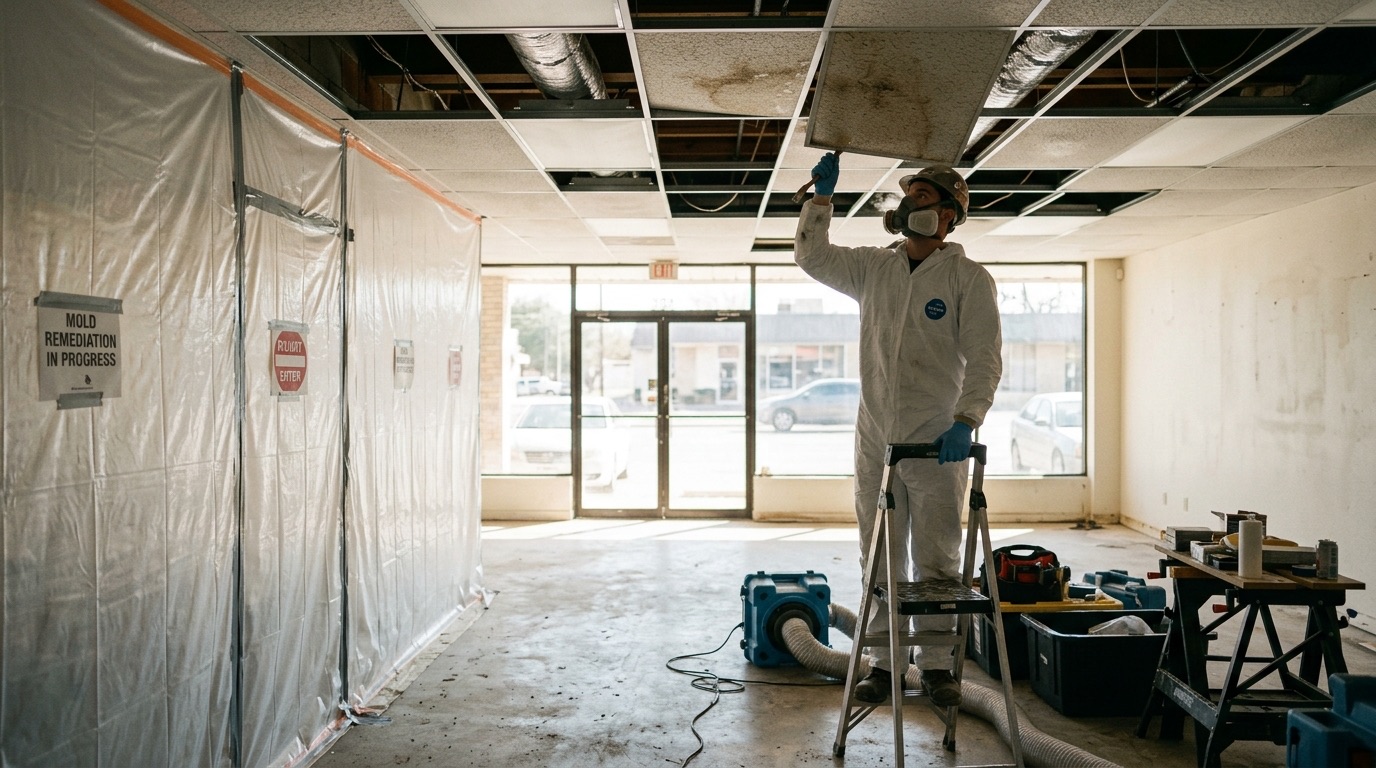
When mold strikes commercial properties, its impact extends beyond mere inconvenience. It can lead to tenant disruption, liability exposure, insurance carrier complications, and a critical need for thorough documentation. At Austin Mold Removal, we collaborate with property managers, building owners, multi-family operators, and facilities teams across Travis, Williamson, Hays, and Comal counties to provide reliable solutions. This page focuses on how commercial mold remediation in Austin is executed effectively, addressing the unique challenges it presents. For comprehensive insights into our range of services, explore all the work our crews handle.
Understanding Commercial Mold Remediation in Central Texas
Commercial properties in Austin often face similar moisture challenges as residential ones, but sometimes more intensely. For example, rooftop HVAC units on flat roofs can collect standing water, and retail spaces with below-grade storage areas often pull humidity through slab edges. Buildings constructed quickly during Austin’s 2010s construction boom might have envelope details that trap moisture within wall cavities. Additionally, schools and light industrial buildings, with high occupancy rates, experience rapid indoor humidity increases.
When mold is found in a commercial property, remediation involves handling occupied areas and business operations, shared HVAC systems, and managing multiple stakeholders with competing schedules. Planning is crucial to avoid costly delays and ensure a smooth project.
Common Mold Causes in Commercial Spaces
Most commercial mold cases in Austin stem from specific sources. Projects often associated with a water event are usual, but the cause might not always be apparent.
Roof and Envelope Failures: Flat commercial roofs often collect water after heavy rain. Membrane damage, clogged scuppers, and failed sealing can let water penetrate roof decks and ceiling structures. Austin's hail season only worsens this situation.
HVAC Condensation and Drain Issues: Rooftop units and split systems in commercial settings produce significant condensate. Drain pan clogs and cracked lines allow water to accumulate in ceiling spaces, dripping onto insulation. If needed, we address evaporator coil and flex duct work work separately.
Plumbing Failures in Multi-Tenant Buildings: A minor leak under a kitchen sink can spread mold to the floor below without initial detection. Multi-family buildings often amplify this issue, as one plumbing problem can affect neighboring units.
Slab Moisture and Below-Grade Storage: Clay soils in Austin retain water after heavy rain. Below-grade storage areas, stairwells in parking garages, and any space at or below ground level are at higher risk for moisture intrusion through slabs and foundation walls.
Inadequate Ventilation in Occupied Spaces: Highly occupied areas with poor ventilation accumulate moisture from occupants. Break rooms, locker areas, server closets without consistent cooling, and bathrooms lacking exhaust fans can lead to persistent humidity that encourages mold over time.
Planning to Minimize Tenant Disruption
For property managers, minimizing tenant disruption while executing mold remediation is vital. We prioritize this by building a project schedule around your operational needs.
In office settings, we stage work section by section, keeping unaffected floors and areas open throughout the project. For retail tenants, we coordinate with store hours and often schedule backroom work overnight. After-hours work is a standard practice when tenant schedules require it.
In multi-family properties, we operate on a unit-by-unit basis. We assess adjacent units, contain each separately, work through the sequence of affected units, and provide residents with advance notice of our access schedules. We strive to keep hallways and common areas functional wherever possible.
Communication is integral to our process. We’ll assist in tenant notification meetings, provide formatted documentation for residents, and keep your maintenance team updated daily.
Begin with start with an on-site review to assess the full scope before committing to remediation.
Our Commercial Mold Remediation Process
- Pre-Project Coordination: We meet with your facilities team or property manager to discuss access, confirm after-hours planning, identify utility shutoff needs, and document affected areas before starting containment.
- Containment Installation: Poly containment barriers and HEPA-filtered air scrubbers are installed to maintain negative air pressure, preventing contamination spread.
- Controlled Demolition and Removal: We remove affected materials like drywall, insulation, and ceiling tiles per the standard the start-to-finish project workflow, documenting everything with photos and sealing debris in bags for disposal.
- HEPA Vacuuming and Antimicrobial Treatment: Surfaces within the containment zone are vacuumed and treated with EPA-approved antimicrobial agents.
- Waste Removal: Bagged debris is promptly removed following Texas waste regulations. We ensure no materials are left for you to manage.
- TDLR Certification: Upon completion, we issue a TDLR Certificate of Mold Damage Remediation, fulfilling Texas state requirements and frequently needed by insurance and property buyers.
Insurance Carrier Coordination
Handling commercial mold claims requires extensive documentation. Insurance carriers need a comprehensive view of the damage source, the scope of work, and verification that tasks were completed successfully.
We provide a detailed work scope before beginning, daily photographic progress documentation, and a completion report detailing materials, treatments, and timelines. The TDLR Certificate of Mold Damage Remediation accompanies every commercial project deliverable.
When required by your insurance carrier, we coordinate with independent licensed Mold Assessment Consultants for remediation protocols or post-remediation verification as Texas law mandates this oversight by a separate contractor. We manage the administrative aspects so that you’re never left scrambling.
Our team is experienced with the major commercial property insurance providers in Texas and prepares required documentation accordingly.
Costs Associated with Commercial Mold Remediation in Austin
Pricing varies based on affected square footage, involvement of building systems, after-hours requirements, and the need for independent containment in multiple units or spaces. Removal per square foot typically costs between $10 and $25, aligning with Angi's Austin mold remediation cost data. After-hours labor and projects needing separate containment zones add to the expense.
We offer fixed-price estimates upfront, ensuring no surprise line items appear mid-project without your approval.
Why Central Texas Property Managers Prefer Our Services
We hold a TDLR Mold Remediation Contractor and our crews possess IICRC AMRT (Applied Microbial Remediation Technician) certification. We provide the TDLR Certificate of Mold Damage Remediation as a project standard.
We understand the diverse commercial building environment across Central Texas, from concrete retail in Round Rock to wood-frame apartments in South Austin, mixed-use structures in East Austin, and light industrial buildings in the tech corridor. Each presents unique moisture challenges we've adeptly handled.
Responsive solutions are key in commercial settings. Reach out any time, as we’re available 24/7 and aim to address commercial inquiries promptly.
Frequently Asked Questions
Do you perform mold testing for commercial spaces?
We handle visual inspections and moisture assessments to define scope, not lab testing. Texas law mandates separation of mold assessment and remediation. We coordinate with independent licensed Mold Assessment Consultants for any required remediation protocol or post-verification, as our license does not cover those tasks.
What is the TDLR Certificate of Mold Damage Remediation?
This certificate confirms that licensed remediation work has been completed as required under Texas law. It includes project specifics and the contractor’s license number. This document is necessary for property owners, insurance claims, and real estate transactions in commercial settings per TDLR Mold Assessors and Remediators guidelines.
How do you ensure minimal tenant disruption during remediation?
We prioritize occupant schedules when planning remediation. This involves sectioning work, scheduling after-hours when needed, erecting containment to keep common areas functional, and notifying tenants of our timeline. Multi-family projects proceed unit by unit, with each unit independently contained.
How long does it take to complete a commercial mold remediation?
Duration varies by severity: a single unit or small space might take two to three days, while widespread contamination or a multi-unit project can take up to three weeks. We provide a projected timeline in our estimate and offer daily updates.
Is mold remediation covered by commercial property insurance?
Coverage depends on the policy, carrier, and damage origin. Many policies cover mold following sudden water events (e.g., burst pipes), but not for issues from long-term neglect. Documentation from us supports your claim process. Consult your carrier or broker to confirm coverage specifics.
Can you operate in occupied buildings or just empty ones?
We regularly work in occupied spaces, maintaining separation with proper containment and filtration. Coordinating with management, we can operate around business hours and lease restrictions, even handling projects in active offices and retail centers.
Are you licensed for commercial work in Texas?
Absolutely. We carry a TDLR Mold Remediation Contractor for both residential and commercial projects. Texas requires this license for compensated remediation work, and our qualifications include IICRC AMRT certification, with a TDLR Certificate issued for every commercial project.
talk to our intake desk to discuss your property and schedule a walkthrough for a clear scope, fixed-price estimate, and a comprehensive plan aligned with your schedule.
Many commercial calls are tied to plumbing failures or roof leaks. We handle these as projects that started with a leak with full documentation for the building owner and any insurance carrier involved.